- Home
- Skirt Pattern Planning
How to Make a Skirt Pattern for a Crochet or Knitting Project
Re-written by Janice Jones, Last Updated December 2025
You don’t need to be a garment designer to make a well-fitting skirt.
Most knit and crochet skirt projects work best when you have a basic plan before you begin, even if you’re following an existing pattern. This page shows you how to create a simple, measurement-based sketch to understand skirt construction and avoid common fit problems.
This is not a sewing pattern, and it’s not meant for sewing projects. Instead, it’s a planning guide explicitly designed for knit and crochet skirts, where fabric behavior, stretch, and gauge matter more than paper pattern drafting.
Who This Guide Is For
This page is helpful if you want to:
- Understand how knit or crochet skirt patterns are structured
- Adjust the length or width of a skirt pattern you’re already using
- Plan a simple straight skirt using your own measurements
- Avoid guesswork before calculating stitches and rows
You do not need to design a skirt from scratch to use this guide. Think of it as a way to see the big picture before you start stitching.
Why a Simple Skirt Plan Helps
Unlike sewing, knitted and crocheted fabric stretches, drapes, and behaves differently depending on yarn, stitch pattern, and gauge. A quick planning sketch helps you:
- Translate body measurements into stitch counts
- Decide where shaping may (or may not) be needed
- Understand how changes to gauge affect fit
- Modify existing skirt patterns with confidence
Even experienced knitters and crocheters often start with a basic measurement guide before committing to a whole project.
What This Page Will (and Won’t) Do
This page will help you:
- Understand the basic shape of a straight knit or crochet skirt
- See how measurements relate to the finished garment
- Prepare to calculate stitches and rows accurately
This page will not:
- Replace a detailed written skirt pattern
- Teach sewing pattern drafting
- Require advanced garment design skills
If the calculations look intimidating at first, that’s okay. You can use this page as a reference, returning to it as needed rather than following every step at once.
How to Use This Guide
Once you understand the basic skirt layout shown here, the usual knit or crochet workflow applies:
- Choose your stitch pattern
- Make a gauge swatch
- Calculate stitches and rows based on your measurements
- Follow or adapt a pattern using this information
You can move through the sections below at your own pace; they’re meant to explain how skirt patterns work, not overwhelm you.
Planning a Skirt for Knit or Crochet Projects
Before starting a knit or crochet skirt, it helps to create a simple planning sketch based on your measurements. This sketch is not a sewing pattern and does not need to be perfectly precise. Its purpose is to help you visualize the skirt's shape and understand how your measurements translate into fabric.
For knit and crochet projects, this kind of planning is invaluable because:
- The fabric stretches and drapes differently from woven fabric
- Gauge plays a significant role in fit
- Small changes in stitch count can significantly affect the final result
Think of this section as a reference guide. You can use as much or as little of it as you need.
Important Notes Before You Begin
- This planning method is intended only for knit and crochet skirts
- It is not suitable for sewing projects
- Working in centimeters is often easier during planning, but inches work just as well
You are creating a measurement guide, not a finished pattern.
Step 1: Take Basic Body Measurements
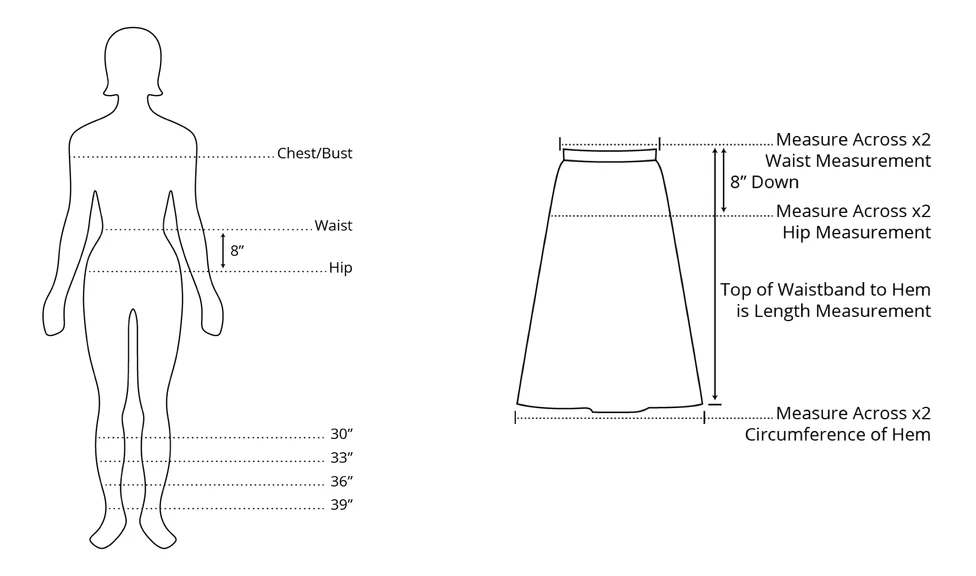
You will need three measurements:
- Hip circumference (HC): Measure around the fullest part of your hips.
- Waist circumference (WC): Measure around your natural waist.
- Skirt length (SL): Measure from your waist down to the desired hem length.
These measurements help determine the width and length of your skirt before calculating the number of stitches and rows.
Tip: Many knit and crochet skirt patterns are based on hip measurements rather than waist measurements because hips usually require more ease.
Step 2: Create a Simple Base Shape
Most straight knit or crochet skirts are based on a rectangular shape.
- The height of the rectangle represents the skirt length
- The width represents a portion of the hip circumference
You only need three measurements to plan most knit or crochet skirts.
| Measurement | What It Means | Why It Matters |
|---|---|---|
| Hip Circumference | Measure around the fullest part of your hips. | Determines the widest part of the skirt so it fits comfortably. |
| Waist Circumference | Measure around your natural waist (where you bend side to side). | Helps decide whether shaping is needed or if fabric stretch is enough. |
| Skirt Length | Measure from your waist to where you want the hem to fall. | Determines how many rows or rounds you’ll work. |
Step 3: Understanding Shaping References
Some skirt patterns include shaping near the waist to improve fit. In knit and crochet garments, this shaping is usually achieved by:
- Changing stitch counts
- Adjusting stitch patterns
- Adding or removing stitches gradually
The reference points shown in the diagram help explain where shaping might be placed, even if you choose not to include it.
You do not need to use every reference line shown. Many simple skirts work perfectly well with minimal or no shaping, especially when the fabric is stretchy.
Step 4: How This Planning Sketch Is Used
Once your basic measurements and layout are understood, you can:
- Calculate stitch counts using your gauge
- Decide whether to follow a pattern “as written” or make small adjustments
- Understand why a skirt pattern increases, decreases, or stays straight
This planning step helps prevent common issues such as:
- A skirt that is too tight at the hips
- Excess fabric at the waist
- Unexpected changes in length
Keep This in Perspective
You are not expected to memorize or master every calculation shown here.
Many knitters and crocheters use guides like this simply to:
- Double-check pattern sizing
- Understand how garments are constructed
- Make confident adjustments when needed
If a section feels too detailed, skip it and come back later. The value of this guide is that it’s here when you need it.
Yarn Types That Work Well for Knit and Crochet Skirts
When choosing yarn for a skirt, drape, weight, and durability matter more than softness alone. The goal is a fabric that holds its shape without becoming stiff or heavy.
Good yarn choices for skirts include:
-
Wool and wool blends
Provide elasticity and structure, helping skirts keep their shape over time. -
Cotton blends
Offer breathability and stability. Pure cotton can work, but may feel heavy if the stitch pattern is dense. -
Linen or linen blends
Create beautiful drapes that are ideal for warm-weather skirts, though they soften with wear. -
Lightweight acrylic blends
It can work for casual skirts, especially when durability and easy care are priorities.
Yarn Weights That Work Best for Knit and Crochet Skirts
Yarn weight plays a significant role in how a skirt drapes, stretches, and holds its shape over time. Because skirts are worn vertically, heavier yarns can pull downward, altering the fit as the garment is worn.
Standard yarn weights and how they perform in skirts:
Fingering weight
Creates lightweight fabric with excellent drape. Ideal for fitted or flowing skirts, especially when paired with simple stitch patterns.
Sport and DK weight
One of the best choices for skirts. These weights balance drape, structure, and durability without becoming too heavy.
Worsted-weight
It can work for skirts, especially shorter styles or structured designs, but may feel heavy in longer garments.
Bulky or super bulky yarns
Usually not recommended for skirts. The extra weight can cause stretching, distortion, and loss of shape over time.
Tip: If you’re unsure, knit or crochet a swatch and hang it for several hours to see how the fabric behaves under its own weight.
Stitch Patterns That Work Well for Knit and Crochet Skirts
When choosing a stitch pattern for a skirt, focus on drape, stretch, and fabric weight. The goal is a fabric that moves comfortably without clinging or losing its shape.
Knitting Stitch Patterns for Skirts
- Stockinette stitch
Creates smooth fabric with excellent drape. Works well when paired with a yarn that has some elasticity. -
Garter stitch (used sparingly)
Offers stretch and stability, but works best in panels, borders, or textured sections rather than the entire skirt. -
Simple ribbing (1×1 or 2×2)
Provides stretch and shape, especially near the waist. -
Lightweight textured stitches
Subtle textures can add interest without adding bulk, as long as the stitch pattern remains flexible.
Crochet Stitch Patterns for Skirts
-
Single crochet (worked loosely)
Creates a stable fabric when paired with the right yarn and hook size. -
Half double crochet
Offers a balance of structure and drape, making it a popular choice for crochet skirts. -
Simple lace or mesh stitches
Add movement and breathability, especially for warm-weather skirts. -
Vertical stitch patterns
Help skirts hang nicely and avoid unnecessary width.
Tip: Always swatch your stitch pattern and hang it for several hours to see how it stretches and drapes before starting the full skirt.
Frequently Asked Questions
Do I need a paper pattern to knit or crochet a skirt?
Do I need a paper pattern to knit or crochet a skirt?
No. Many knit and crochet skirts are planned using basic body measurements, gauge, and fabric stretch rather than a traditional paper pattern.
Is this the same as a sewing skirt pattern?
Is this the same as a sewing skirt pattern?
No. Sewing patterns are designed for woven fabric, while knit and crochet skirts rely on the flexibility of the fabric and the gauge. This guide focuses only on knit and crochet projects.
Can I use this guide with an existing skirt pattern?
Can I use this guide with an existing skirt pattern?
Yes. This guide helps you understand how skirt patterns are structured so you can follow instructions more confidently or make small adjustments if needed.
Gore Skirt Pattern: Easy to do.
Crochet a Skirt of motifs: Easy and fun project.
Gored Skirt: How to knit or crochet it
Disclosure:
This post contains affiliate links. If you buy through them, I may earn a small commission at no extra cost to you.
Janice Jones is a Certified Knitting and Crochet Instructor who creates beginner-friendly patterns and tutorials, backed by a 389-page library of practical knitting and crochet content.
Most Popular Pages
Comprehensive Guide to Yarn

All Types of Crochet Stitches
36 Reversible Knit Stitch Glossary
How to Crochet the Second Row
Dog Sweater Patterns
Working with Alpaca Yarn
Free eBooks, Just for You
Get my beginner eBook guides to Knitting and Crocheting, just for signing up for my monthly newsletter.
Choose one or both when you sign up.
About the Author: Please allow me to introduce myself
Janice Jones is a Certified Knitting Instructor and Certified Crochet Instructor through the Craft Yarn Council who focuses on beginner-friendly patterns, stitch guides, and technique tutorials. She has built a library of 389 pages on her website, sharing practical instructions and patterns, and has completed projects ranging from crochet blankets to knit sweaters. You can explore her work on her website. She makes items for Warm Up America and often knits and crochets sweaters for her small dogs.
Thank you for visiting Smart-Knit-Crocheting. I hope this and all of my tutorials will give you the inspiration to continue your knit or crochet journey. For a complete list of all the pages on my site, please visit my table of contents.
I participate in the Amazon Services LLC Associates Program, an affiliate advertising program designed to provide a means for sites to earn advertising fees by advertising and linking to Amazon.com. “As an Amazon Associate I earn from qualifying purchases.” These earnings go towards supporting my website.
Home | Contact | About | Privacy Policy | Disclaimer
I DO NOT SELL ANY PERSONAL INFORMATION FROM THIS WEBSITE. PLEASE SEE MY PRIVACY POLICY FOR MORE DETAILS.
Copyright © 2006-2026 Smart Knit Crocheting. All Rights Reserved
Please Share
Remember, Sharing is Caring